
Universal joints are the most mechanically stressed components in any PTO drive shaft assembly. They absorb angular misalignment between the tractor PTO output and the implement input while transmitting full engine torque at high rotational speed. They operate in harsh conditions — exposed to dust, moisture, impact loads, and temperature extremes — and they are the component most likely to fail first if maintenance is neglected.
Despite their critical role, universal joints are often the least understood part of the PTO system. Many operators cannot distinguish between a standard cross joint and a wide-angle constant-velocity joint, do not know the maximum safe operating angle for their shaft, and cannot recognize the early warning signs of bearing failure until the joint seizes completely. This guide addresses all of these knowledge gaps.
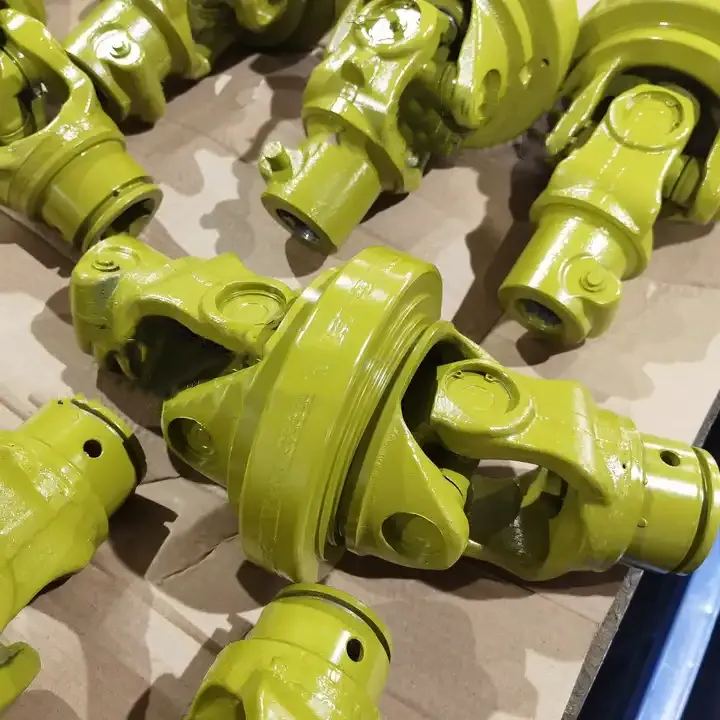
Wide-angle universal joint — capable of operating at angles up to 80 degrees where standard cross joints cannot
How a Universal Joint Works
A universal joint — also called a U-joint, Cardan joint, or cross joint — consists of two yokes connected by a cross-shaped intermediate piece (the “cross” or “spider”). Each arm of the cross sits inside a bearing cup pressed into the yoke ears. This arrangement allows the two yokes to pivot relative to each other in two planes simultaneously, enabling the shaft to transmit torque even when the input and output axes are not aligned.
The key engineering limitation of a standard U-joint is that it does not produce constant velocity output when operating at an angle. If the input shaft rotates at a steady 540 RPM, the output shaft actually speeds up and slows down twice per revolution — a phenomenon called cyclic speed variation. The magnitude of this variation increases with the operating angle. At 10 degrees, the speed fluctuation is approximately 3%. At 25 degrees, it reaches nearly 10%. This is why PTO shafts use a pair of U-joints phased 90 degrees apart — the speed variation from the second joint cancels the variation from the first, restoring near-constant velocity at the output.
Types of Universal Joints Used in Agricultural PTO Shafts
Standard Cross Joint (Cardan Joint)
The most common type in agricultural PTO applications. Consists of a steel cross with four arms, each fitted with a needle roller bearing cup. Rated for continuous operating angles up to 15–25 degrees depending on size and speed. Available in multiple series sizes — the most common agricultural series include Series 1 (light duty, up to ~15 HP), Series 4 (medium duty, up to ~50 HP), Series 6 (heavy duty, up to ~100 HP), and Series 8 (extra heavy duty, 100+ HP). The series designation determines the cross dimensions, bearing cup diameter, and torque capacity.
Wide-Angle Joint (W.A. Joint)
Designed for applications requiring operating angles beyond the 25-degree limit of standard cross joints. Wide-angle joints can accommodate angles up to 80 degrees, making them essential for implements that must operate in steep terrain or with significant vertical travel relative to the tractor — such as front-mounted mowers, steeply angled grain augers, or implements used on hillside tractors. The wide-angle PTO shaft with EC legislation compliance combines this angular capability with the safety shielding required for European markets.
Constant Velocity (CV) Joint
A double-Cardan or ball-type joint that maintains true constant velocity output regardless of operating angle. Used in premium PTO shafts where smooth, vibration-free power transmission is critical — typically on high-speed implements like air seeders or precision planters where speed fluctuations would affect application accuracy. CV joints are significantly more expensive than standard cross joints and are not necessary for most general agricultural applications.
Friction Clutch Joint (Overload Protection)
Not a universal joint type per se, but a torque-limiting device often integrated at or near the joint location. When the driveline encounters a sudden overload — a mower blade hitting a rock, an auger jamming with frozen material — the friction clutch slips momentarily to absorb the shock before it damages the gearbox or PTO stub. Available as bolt-on accessories or as integrated components within the PTO shaft assembly.
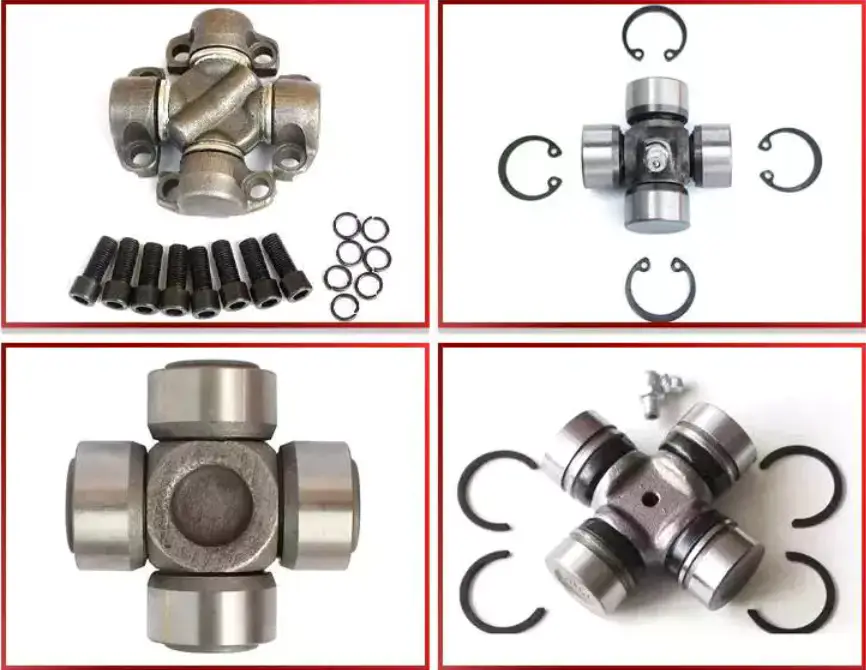
Universal joint types compared — each design serves a different operating angle and performance requirement
5 Common U-Joint Failure Modes and Their Causes
Recognizing how universal joints fail helps you prevent failures before they become dangerous or expensive.
Bearing Cup Wear (Most Common)
Cause: Insufficient or infrequent greasing. The needle rollers inside the bearing cups run dry, overheat, and develop flat spots. Symptoms: Clicking sound at low speed, noticeable play when rocking the shaft by hand. Prevention: Grease every 8–10 operating hours without exception.
Seized Joint (Locked Cross)
Cause: Advanced bearing wear that progresses to metal-on-metal contact. The cross welds itself to the bearing cups. Symptoms: Shaft vibration that worsens over time, eventually constant vibration even at idle speed. Consequence: A seized joint forces all angular compensation onto the remaining joint, which then fails rapidly. Can also fracture the yoke ears.
Cross Arm Fracture
Cause: Fatigue from chronic overloading, impact shocks exceeding the cross material rating, or a manufacturing defect. Symptoms: Sudden loss of drive with a metallic snap. Consequence: The shaft separates and can whip violently. This is a critical safety hazard — always maintain safety shields in place to contain a broken shaft.
Bearing Cup Corrosion
Cause: Water ingress through damaged seals, especially on equipment stored outdoors. Moisture corrodes the needle rollers and cross arm surfaces. Symptoms: Stiff joint movement, grinding noise, rust-colored grease when pumping. Prevention: Store PTO shafts indoors or under cover. Apply grease before seasonal storage to purge moisture.
Excessive Operating Angle
Cause: Implement mounted too high, too low, or on uneven terrain that exceeds the joint’s rated angle. Symptoms: Accelerated bearing wear, cyclic vibration, overheating at the joint. Standard joints operating continuously above 25 degrees will fail within weeks. Solution: Adjust implement height or upgrade to a wide-angle joint rated for the required angular range.
How to Select the Right Universal Joint for Your Application
When replacing a universal joint — either as a cross kit or as part of a complete PTO shaft — the following parameters must be matched precisely:
✓
Series size — The cross dimensions (bearing cap outside diameter and cross arm span) must match the yoke bore. Mixing series sizes is impossible without yoke replacement.
✓
Torque rating — Must meet or exceed the maximum torque your PTO can deliver. A 75 HP tractor at 540 RPM produces approximately 1,030 Nm of torque at the PTO stub. Select a joint rated at least 20% above this value.
✓
Maximum operating angle — Measure the angle between the tractor PTO stub and the implement input shaft with the implement in working position. If this exceeds 15 degrees, select a joint rated for that angle. If it exceeds 25 degrees, you need a wide-angle joint.
✓
Grease fitting type — Confirm the cross has accessible grease fittings (zerks). Some economy joints are “sealed for life” — which in agricultural reality means “sealed until failure.” Greasable joints last significantly longer.
✓
Bearing cap retention method — Snap rings (most common), staked caps, or U-bolt retention. Must match the yoke design. Using the wrong retention method results in bearing caps walking out under vibration.
When replacing individual cross kits, always replace both joints on the shaft at the same time if both show any signs of wear. A new joint paired with a worn joint creates an imbalanced driveline that transfers stress unevenly. For high-precision PTO shafts where both joints and the telescopic tubes are engineered as a matched set, replacing the complete assembly is often the most reliable approach.
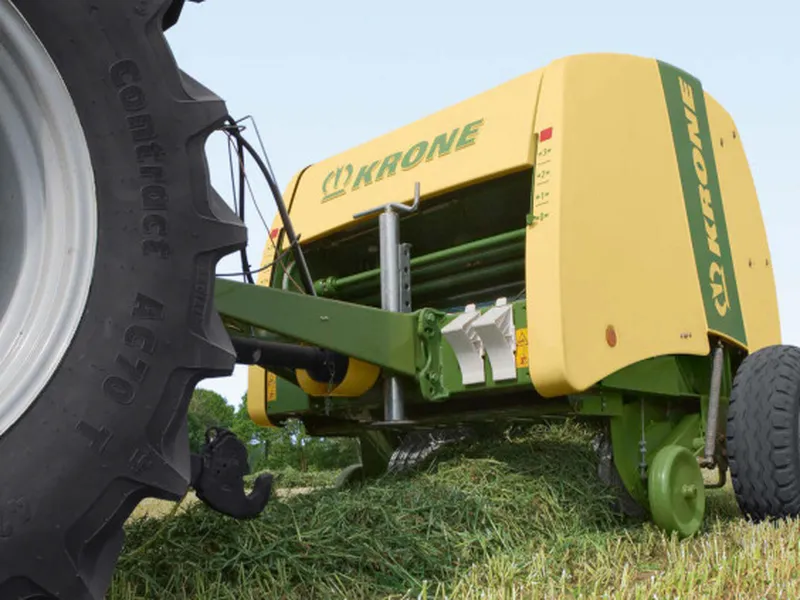
A correctly installed PTO shaft — universal joints at both ends work together to cancel cyclic speed variation
The Bigger Picture: U-Joints as Part of the Complete Drivetrain
Universal joints do not exist in isolation. They are one link in a chain that includes the tractor PTO output bearing, the shaft tubes, the telescopic section, the implement gearbox input bearing, and the hydraulic positioning system that controls the implement angle. A failure or misadjustment in any of these connected components directly affects U-joint life.
A worn tractor PTO output bearing creates a wobbling input that forces the U-joint to compensate for misalignment every revolution. A sagging hydraulic lift cylinder allows the implement to drop, increasing the operating angle beyond safe limits. A gearbox with a damaged input bearing transmits vibration back through the shaft into the U-joint bearings.
Modern agricultural equipment relies on a tightly integrated drivetrain where universal joints, PTO shafts, gearboxes, and hydraulic cylinders must all work together seamlessly. Sourcing these components from manufacturers with cross-product expertise — rather than separate single-product vendors — reduces interface mismatches and simplifies procurement. Learn how integrated transmission component manufacturers approach this challenge by producing PTO shafts, gearboxes, and hydraulic cylinders under one quality management system.
U-Joint Maintenance: The Single Habit That Prevents 90% of Failures
Grease. On schedule. Every time. The overwhelming majority of U-joint failures are caused by inadequate lubrication. Needle roller bearings inside the cups require a thin film of grease to separate the rollers from the cross arm surface. Without it, metal contacts metal, heat builds, rollers develop flat spots, and the joint progresses from “slight click” to “seized solid” in a matter of hours under load.
Interval: Every 8–10 operating hours, or before each day of heavy use. Use lithium-based EP2 grease applied through the cross fitting until fresh grease appears at all four bearing cup seals.
Technique: Pump slowly. If grease does not emerge from one or more bearing seals, the grease channel inside the cross may be blocked — a sign of internal corrosion. Replace the cross kit immediately rather than forcing grease through a blocked channel, which can blow out a seal.
Storage: Before seasonal storage, grease all joints generously to purge any moisture that has entered during the operating season. Store the PTO shaft indoors or under weatherproof cover, ideally in the horizontal position to prevent grease from migrating away from bearing surfaces.
For questions about universal joint specifications, cross kit sizing, or complete PTO shaft replacement, contact our team for expert assistance.