
PTO shafts are among the most dangerous components on any farm. They rotate at 540 or 1,000 revolutions per minute, they are often at waist height, and they are powerful enough to entangle a loose sleeve, pant leg, or strand of hair before the operator can react. Serious entanglement injuries occur in fractions of a second and are frequently fatal.
The vast majority of PTO accidents are preventable. They result from missing or damaged safety shields, deferred maintenance, worn components that fail under load, and — most commonly — operators who become complacent around equipment they use every day. This guide covers the practical safety knowledge every farmer and equipment operator needs: how to inspect your PTO system before each use, how to maintain it properly through the season, when components need replacement rather than repair, and what related systems to check at the same time.
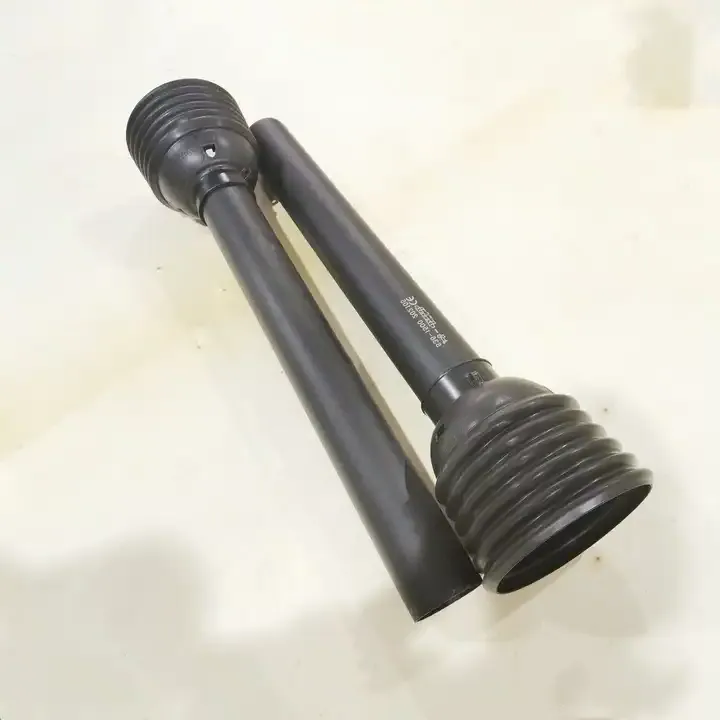
A properly installed PTO safety shield — the single most important protective barrier between the operator and the rotating driveline
Understanding the Risk: How PTO Injuries Happen
A PTO shaft rotating at 540 RPM completes nine full revolutions every second. At 1,000 RPM, it completes nearly seventeen. At these speeds, human reaction time is irrelevant — by the time the brain registers contact, the body has already been wrapped around the shaft multiple times.
The three most common PTO accident scenarios are:
Clothing entanglement
Loose sleeves, untucked shirts, drawstrings, scarves, or open jackets catch on the rotating shaft or universal joint and pull the person into the driveline. This is the most common accident type and the one most often fatal.
Stepping over a spinning shaft
Operators sometimes step over or reach across a PTO shaft that is still engaged, misjudging clearance. Even brief contact with a spinning shaft at knee or hip height can result in catastrophic injury.
Component failure during operation
A worn universal joint that seizes can cause the shaft to shear or whip violently. A yoke that separates under load can release a spinning shaft segment. These mechanical failures turn a contained driveline into an uncontrolled projectile.
Every one of these scenarios is preventable through proper shielding, regular inspection, timely component replacement, and disciplined operating habits.
The 10-Point Pre-Use Inspection Checklist
This inspection should be performed before every use season and repeated weekly during periods of heavy operation. It takes approximately 10–15 minutes and requires only basic hand tools and a grease gun.
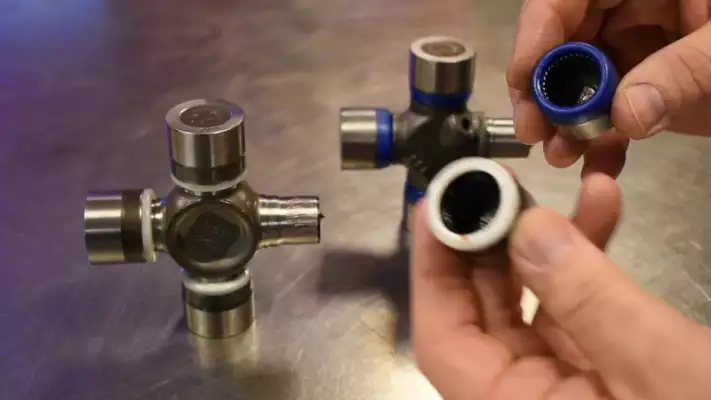
Universal joint cross kit — inspect bearing cups for wear and replace at the first sign of play
1
Safety shield integrity — Is the plastic guard present on the full length of the shaft? Are there cracks, holes, or missing sections? Does the shield rotate freely on its bearings, or is it seized and spinning with the shaft? A shield that co-rotates is no safer than no shield at all.
2
Shield chain or restraint — The shield must be anchored at both ends to prevent it from rotating. Check that the restraining chains or clips are connected and intact.
3
Universal joint play — Grip the shaft on each side of a U-joint and rock it. Any perceptible looseness indicates worn bearing cups. Replace the cross kit before the joint seizes — a seized joint can shatter under load.
4
Yoke locking pins — Test both yoke connections. Push pins should snap fully into the locking groove with an audible click. Interfering bolts should be tight. If a yoke can be pulled off by hand, the locking mechanism has failed.
5
Telescopic section condition — Separate the inner and outer tubes. Check the profile surfaces for wear grooves, galling, or corrosion. The tubes should slide freely when lubricated. Binding or excessive play indicates replacement is needed.
6
Shaft tube straightness — Sight along the length of the shaft tubes. Any visible bend means the shaft is out of balance and will vibrate dangerously at operating speed. Bent tubes cannot be straightened — replace the entire shaft.
7
Yoke ear condition — Inspect the yoke ears for cracks, especially around the pin bore holes. Hairline cracks can propagate rapidly under cyclic loading. Also check for elongated pin holes, which indicate wear.
8
Overload protection — If equipped with a slip clutch, verify it is adjusted to the correct torque setting. If using a shear bolt, confirm the bolt is the correct grade and diameter — never substitute a harder bolt, as this defeats the purpose of the sacrificial protection.
9
Tractor PTO stub condition — Check the PTO output stub on the tractor for worn splines, cracks, or a loose output bearing. A wobbling PTO stub creates angular misalignment that accelerates U-joint wear.
10
Operating angle — With the implement in the working position, estimate the angle between the tractor PTO stub and the implement input shaft. Standard U-joints are rated for 15–25 degrees. If the angle is greater, you need a wide-angle PTO shaft with EC-compliant safety shielding rated for the required angular range.
Seasonal Maintenance Schedule
Consistent maintenance extends PTO shaft life by years and prevents the kind of in-field failures that create both safety hazards and expensive downtime.
Every 8–10 Operating Hours:
Grease all universal joint fittings using lithium-based EP (extreme pressure) grease. Pump until fresh grease appears at all four bearing caps of each U-joint. Failure to grease U-joints is the single most common cause of premature PTO shaft failure.
Every 50 Operating Hours or Monthly:
Separate the telescopic tubes, clean off old grease and debris, inspect the profile surfaces for wear, and apply fresh grease over the full length. Also inspect all safety shield segments and chains for damage.
Start of Each Season:
Perform the complete 10-point inspection checklist above. Replace any components that show wear beyond serviceable limits. Consider replacing the full shaft assembly if it has been in heavy service for five or more seasons.
When to Replace vs. Repair: The Decision Framework
Not every worn component requires a full shaft replacement. But knowing where the line falls between repairable wear and replacement-level damage saves both money and risk.
| Condition | Action | Reason |
|---|---|---|
| U-joint has slight play | Replace cross kit | Cross kits are inexpensive and restoring tight bearing fit extends shaft life |
| Safety shield cracked | Replace shield | Shields are available separately and must never be operated in damaged condition |
| Telescopic tubes stick even when greased | Replace shaft | Profile surfaces are galled; the shaft will jam during operation causing sudden driveline stress |
| Shaft tube is visibly bent | Replace shaft immediately | A bent tube is out of balance; vibration at operating speed damages U-joints, gearbox, and PTO stub |
| Yoke ears cracked or pin holes elongated | Replace shaft immediately | Yoke failure under load can release the spinning shaft — a critical safety hazard |
| Multiple components worn simultaneously | Replace complete assembly | Replacing individual parts on a generally worn shaft results in repeated failures; a new complete assembly is more cost-effective |
As a general rule: if the total repair cost for cross kits, tubes, and yokes exceeds 50–60% of a new PTO shaft assembly price, replace the entire unit. A new shaft provides matched components, a full warranty, and a fresh safety shield — a far better investment than piecemeal repairs on aging hardware.
Don’t Forget: Check Connected Components at the Same Time

The hydraulic lift cylinder works alongside the PTO shaft — a leaking cylinder affects implement angle and driveline safety
When servicing or replacing a PTO shaft, it is good practice to inspect the connected components at the same time. A new PTO shaft cannot compensate for failures elsewhere in the driveline or the implement’s hydraulic system.
Implement Gearbox
Check the gearbox oil level and condition. Listen for unusual noise when rotating the input shaft by hand. Inspect the input shaft spline for wear. A damaged gearbox will destroy a new PTO shaft’s U-joints through transmitted vibration.
Hydraulic Lift Cylinder
The hydraulic cylinder that raises and lowers the implement directly affects PTO shaft operating angle. A leaking cylinder that allows the implement to sag increases the U-joint angle beyond safe limits. For equipment needing cylinder replacement, replacement lift hydraulic cylinders are available from the same type of transmission component manufacturers that supply PTO parts.
Three-Point Hitch
Worn hitch pins, bent lift arms, or a malfunctioning position control valve all affect the implement’s stability and alignment relative to the tractor PTO output. An unstable implement creates oscillating shaft angles that accelerate U-joint wear.
7 Non-Negotiable PTO Safety Rules
1. Never operate a PTO shaft without the safety shield in place. No exceptions. Not even “just for a minute.”
2. Always disengage the PTO and turn off the engine before approaching the driveline for any reason — clearing a blockage, checking a connection, or making adjustments.
3. Never step over a rotating PTO shaft. Walk around the equipment, even if it takes longer. This single habit has saved countless lives.
4. Wear close-fitting clothing with no loose sleeves, cuffs, drawstrings, or dangling accessories when working near PTO equipment.
5. Keep bystanders — especially children — away from the area when PTO equipment is operating. Establish a clear exclusion zone.
6. Never attempt to slow or stop a PTO shaft by hand or with a tool. Disengage the PTO at the tractor and allow it to coast to a stop.
7. Replace damaged safety shields immediately — do not continue to operate while waiting for a replacement part. The cost of a new shield is negligible compared to the cost of an accident.
PTO safety is not complicated. It requires equipment in good condition, shields in place, disciplined habits, and the willingness to shut down and walk around rather than take shortcuts. The few minutes saved by a shortcut are never worth the consequences.
For questions about PTO shaft inspection, replacement parts, or safety shield availability, contact our team for expert assistance.