
The gearbox is the critical link between your PTO shaft and the implement it drives. It converts the fixed PTO speed — typically 540 or 1,000 RPM — into the exact rotational speed and direction your tool requires. A rotary mower needs its blades spinning at 300–400 RPM on a vertical axis. A feed mixer needs its augers turning at 20–40 RPM. A manure spreader might need 80 RPM with very high torque. The gearbox makes all of this possible.
Yet choosing the wrong gearbox is one of the most common — and most expensive — mistakes in agricultural equipment setup. An undersized gearbox strips gears within a season. A mismatched spline interface damages the PTO shaft yoke. A wrong ratio either overloads the implement or leaves it turning too slowly to function properly.
This guide walks through every factor you need to consider when selecting an agricultural gearbox to pair with your PTO drive shaft system.
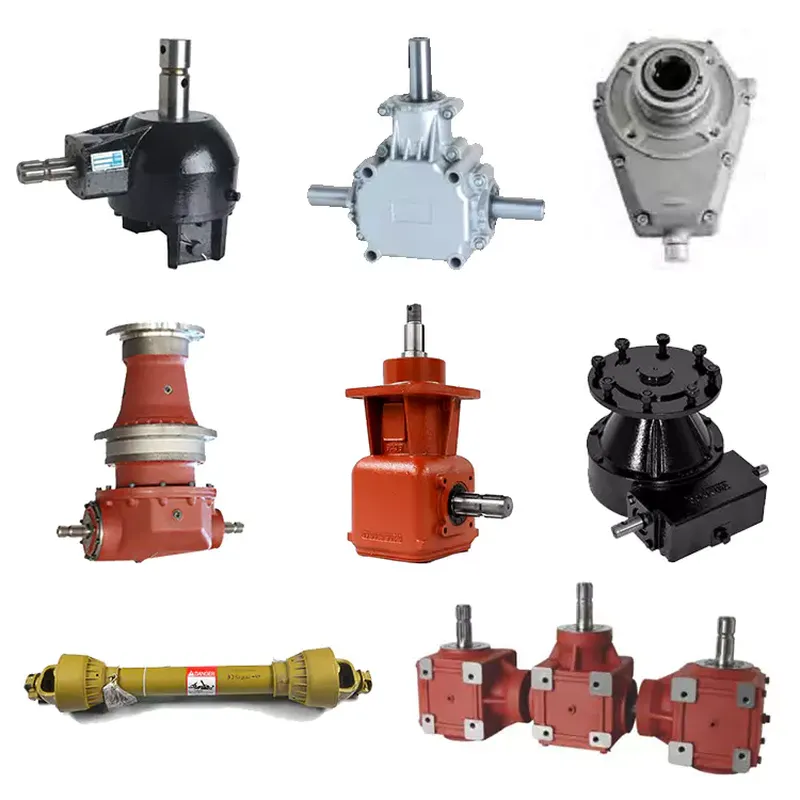
Agricultural gearboxes convert PTO speed and direction to match the requirements of each implement
How Agricultural Gearboxes Work with Your PTO Shaft
When you engage the PTO on your tractor, the PTO output stub rotates at a fixed speed. Your PTO drive shaft transfers that rotation to the implement. But the implement almost never needs exactly 540 or 1,000 RPM — and it often needs the axis of rotation changed from horizontal to vertical or at an angle. This is where the gearbox steps in.
The gearbox performs up to three functions simultaneously:
Speed Reduction
Converts high-speed PTO input (540/1000 RPM) to the lower speed the tool requires, while proportionally increasing torque.
Direction Change
Redirects the axis of rotation — most commonly a 90-degree turn from horizontal PTO input to vertical blade output.
Torque Multiplication
Gear reduction multiplies torque in inverse proportion to speed reduction — lower output speed means higher available torque at the tool.
Types of Agricultural Gearboxes by Application
Different farm implements demand different gearbox configurations. Selecting the correct type starts with understanding your application.
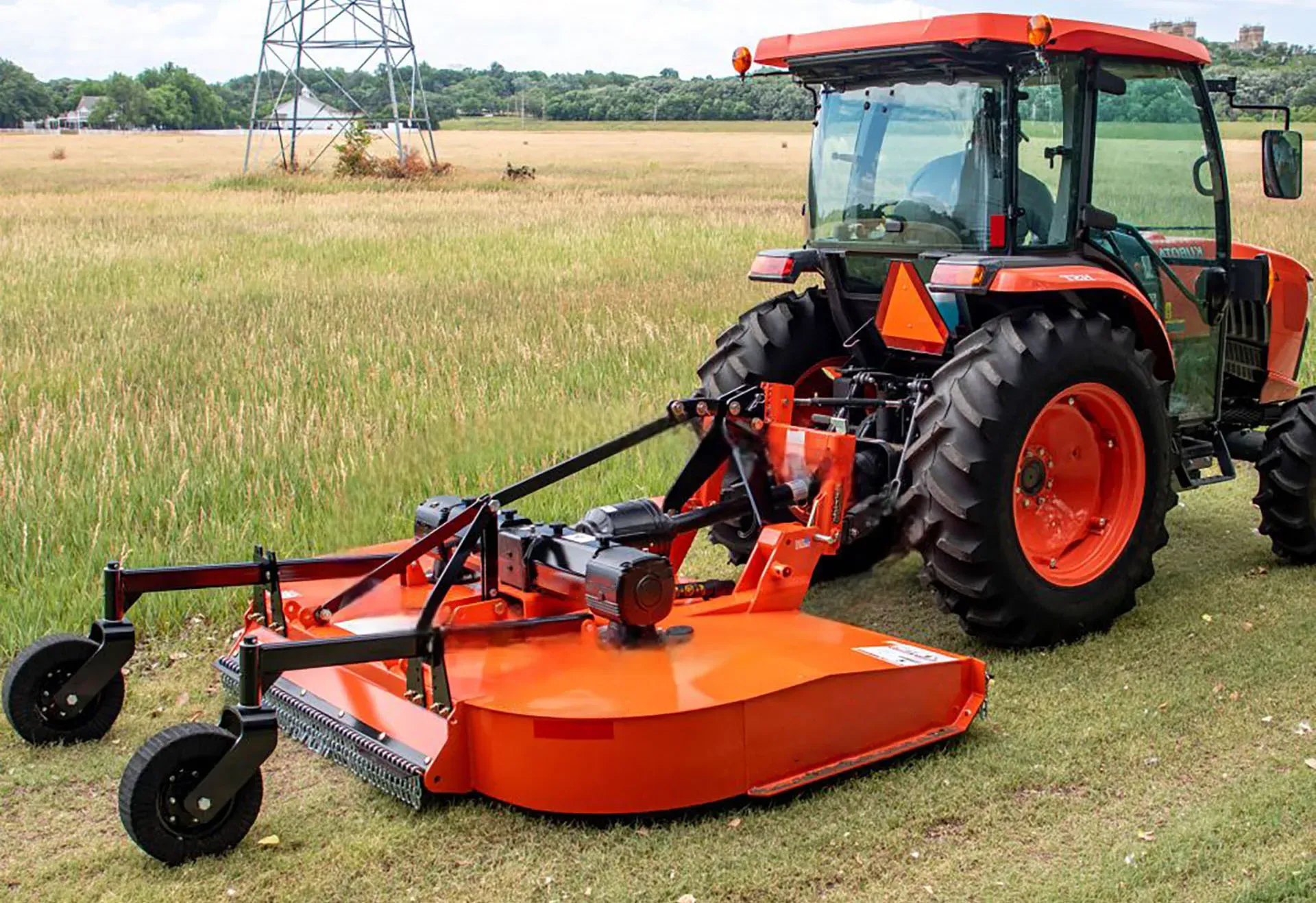
A rotary cutter gearbox in operation — converting horizontal PTO input to vertical blade rotation
Rotary Cutter / Mower Gearbox
The most common agricultural gearbox type. Uses bevel gears to make a 90-degree direction change from horizontal PTO input to vertical blade output. Typical ratios range from 1:1 to 1:1.93, producing blade speeds of 280–540 RPM. Designed to handle the shock loads of blade-to-obstacle impacts. Usually rated for 540 RPM PTO input with horsepower ratings from 25 HP to 150+ HP depending on the implement size.
Rotary Tiller / Cultivator Gearbox
Similar to mower gearboxes in basic design but built for continuous high-torque operation against soil resistance. Often feature higher reduction ratios (1:2 to 1:3) to deliver maximum torque at relatively low tine speed. Must withstand constant abrasive loading and typically include heavy-duty oil seals to prevent soil and moisture ingress.
Feed Mixer / Spreader Gearbox
These gearboxes provide very high reduction ratios (1:10 to 1:30) to drive heavy augers and beaters at low speed but extreme torque. The PTO input at 540 RPM might be reduced to just 20–50 RPM at the output. Planetary gear stages are sometimes used for these high-ratio applications to keep the gearbox compact.
Post Hole Digger / Auger Gearbox
A right-angle gearbox that drives a vertical auger for drilling fence post holes. Features moderate reduction ratios and must handle intermittent high loads when the auger hits rocks or dense clay. Typically compact and lightweight since the gearbox hangs vertically below the tractor three-point hitch.
Hay Baler Gearbox
Balers — especially large round balers — demand high continuous power. Their gearboxes are rated for 1,000 RPM PTO input and must transfer 80–150+ HP without overheating. Heavy-duty bearings, high-capacity oil sumps, and sometimes external oil coolers are standard features. These are among the most expensive and robust agricultural gearboxes.
6 Critical Factors for Choosing the Right Gearbox
Beyond application type, the following parameters must be matched precisely to ensure reliable performance and avoid premature failure.
1
Input Speed Compatibility (540 or 1,000 RPM)
The gearbox input must match your tractor PTO speed. A gearbox designed for 540 RPM input that receives 1,000 RPM will overspeed, overheat, and fail rapidly. Check both the PTO speed and the spline interface — 540 RPM uses a 6-spline 1-3/8″ input, while 1,000 RPM uses a 21-spline 1-3/4″ input. The PTO shaft connecting the two must also match both ends.
2
Gear Ratio and Output Speed
Calculate the required output speed from the implement manufacturer’s specification, then select a gearbox ratio that delivers it. For example, if your rotary cutter blades need 350 RPM and your PTO outputs 540 RPM, you need a ratio of approximately 1:1.54. Common stock ratios include 1:1, 1:1.47, 1:1.93, and 1:2.5 — if none matches exactly, choose the closest ratio that keeps the output within the implement’s acceptable speed range.
3
Horsepower Rating
The gearbox HP rating must exceed the maximum power your tractor can deliver to the PTO. A 75 HP tractor typically delivers 60–65 HP at the PTO. Select a gearbox rated at least 20% above this figure to provide a safety margin for shock loads and peak demands. An undersized gearbox is the number one cause of premature gear failure in agricultural applications.
4
Spline Interface Matching
The gearbox input shaft spline must precisely match the implement-side yoke of your PTO drive shaft. Common agricultural spline standards include 6-spline 1-3/8″, 20-spline 1-3/8″, and 21-spline 1-3/4″. A mismatch — even by one spline — means the shaft cannot connect. Always verify the spline count and diameter of both the gearbox input and the PTO shaft yoke before purchasing.
5
Output Shaft Orientation and Mounting
Agricultural gearboxes come in several mounting configurations: right-angle (most common for mowers and tillers, 90-degree turn), inline (no direction change, pure speed reduction), and offset (for applications requiring a parallel shaft displacement). The output shaft direction and bolt pattern must match your implement frame exactly. An incompatible mounting means the gearbox physically will not fit.
6
Gear Type and Durability
Agricultural gearboxes primarily use spiral bevel gears (smooth, quiet, high efficiency) or straight bevel gears (cheaper, noisier, adequate for intermittent use). For heavy continuous-duty applications, look for case-hardened gears with a Rockwell hardness of HRC 58–62 on the tooth surface. Oil capacity and cooling design also matter — high-duty gearboxes should have adequate oil volume and, in some cases, external cooling provisions to prevent thermal degradation.
5 Common Gearbox Selection Mistakes to Avoid
❌ Mistake 1: Choosing a gearbox based on price alone. A $200 gearbox that fails mid-harvest costs far more in downtime and crop loss than a $400 gearbox that lasts five seasons.
❌ Mistake 2: Ignoring the HP safety margin. A gearbox rated at exactly your PTO horsepower will be running at 100% capacity continuously — leading to overheating and shortened life. Always oversize by at least 20%.
❌ Mistake 3: Assuming all 540 RPM gearboxes have the same spline. The 6-spline and 20-spline versions both operate at 540 RPM but have different interface dimensions. Verify the spline count, not just the RPM.
❌ Mistake 4: Forgetting to check the rotation direction. Some gearboxes output clockwise, others counterclockwise. If the implement requires a specific rotation direction (most mowers need clockwise when viewed from above), the gearbox must match.
❌ Mistake 5: Not replacing the PTO shaft at the same time as the gearbox. A worn PTO shaft with excessive U-joint play transmits vibration into the new gearbox, accelerating wear on the new gear teeth and bearings.
Where to Source Reliable Agricultural Gearboxes
When sourcing a replacement gearbox, matching the spline count and input RPM to your PTO shaft is critical. Manufacturers that produce both PTO shafts and gearboxes understand this interface better than component-only suppliers. For a wide range of agricultural gearboxes compatible with standard PTO configurations, look for suppliers with ISO 9001 certification and documented spline-interface testing — this ensures the gearbox input will mate correctly with your PTO shaft yoke without modification.
Key sourcing criteria to evaluate include: gearbox HP rating verified by independent testing, gear hardness specification (request HRC data), oil seal quality (double-lip seals minimum for agricultural dust exposure), and availability of replacement gears and bearings for long-term maintenance. A gearbox that cannot be serviced is a gearbox that will eventually need complete replacement rather than a simple rebuild.
Gearbox Maintenance: Keeping Your Drivetrain Healthy
Check oil level before every use — most agricultural gearboxes have a sight glass or dipstick. Low oil is the fastest path to gear failure. Use the oil grade specified by the manufacturer (typically EP 80W-90 or equivalent).
Change oil annually or every 500 hours — whichever comes first. Drain warm oil, flush if contaminated, and refill to the correct level. Inspect the drained oil for metal particles, which indicate gear tooth wear.
Inspect seals for leaks each season — oil leaking from the input or output shaft seals will eventually starve the gears. Replace seals at the first sign of weeping. Operating in dusty conditions accelerates seal wear.
Listen for unusual noise — a healthy gearbox hums; a failing gearbox whines, clicks, or growls. New noises under load indicate gear tooth damage, bearing wear, or low oil. Stop immediately and investigate.
Inspect the full driveline together — when servicing the gearbox, also check the PTO shaft for U-joint play, telescopic sleeve condition, and safety shield integrity. The gearbox, shaft, and overload protection device function as a system — a failure in one component stresses all others.
For questions about gearbox specifications, PTO shaft compatibility, or pricing, contact our team for expert assistance.